
Documenting IA

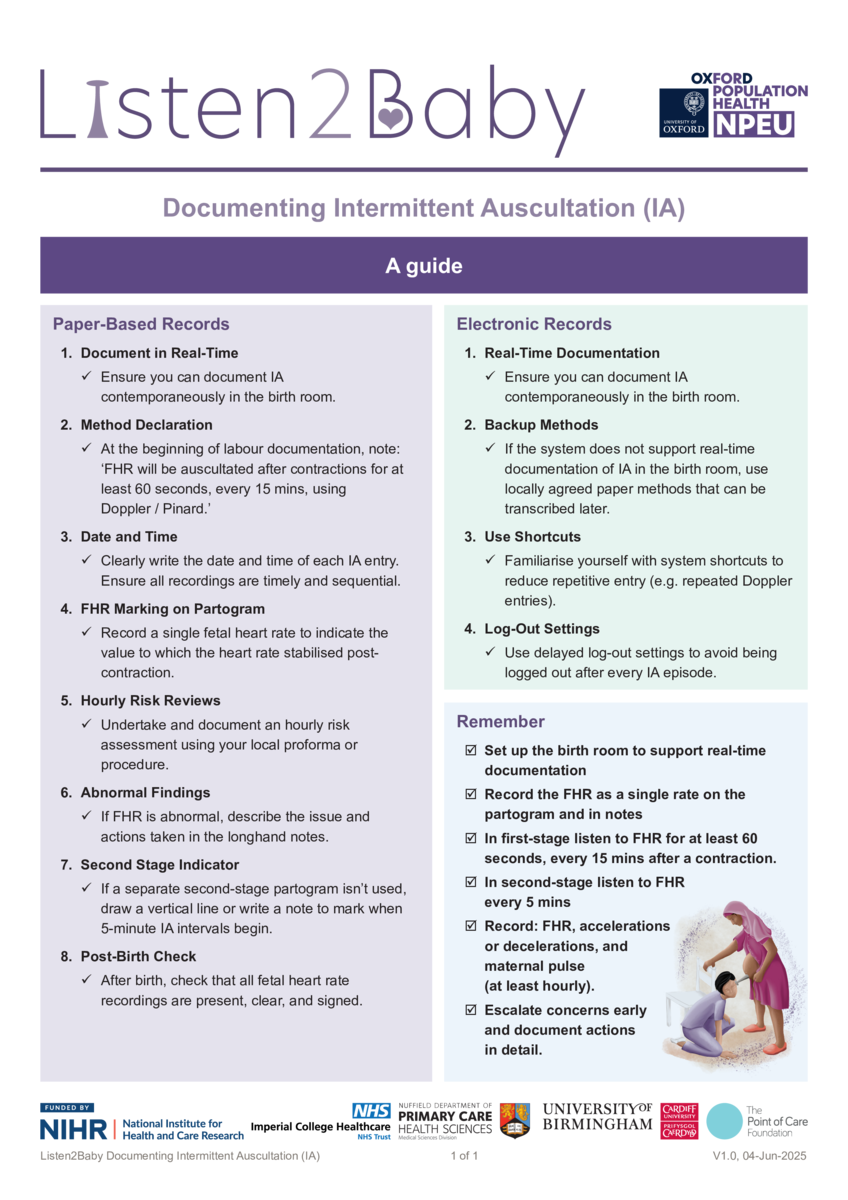
These resources are designed to strengthen the documentation of IA (the routine information recorded during practice) to improve the quality and safety of IA practice.
Why is this important?
Midwives are expected to complete records at the time or as soon as possible after an event, recording if the notes are written after the event [The Code: Professional standards of practice and behaviour for nurses, midwives and nursing associates; paragraph 10], such as when documenting details of a birth or perineal suturing.
Midwives are expected to record in real time the fetal heart rate and any accelerations and/or decelerations heard, throughout labour.
Inadequate and inaccurate record keeping has been highlighted as a recurring theme and contributing factor in sub-optimal care in confidential enquiries into stillbirths and infant deaths (e.g. MBRRACE-UK, 2017).
What Listen2Baby found
A case-note audit of 115 births that used IA at some point, in seven settings, found variation in the documenting of IA and in the completeness of documentation (in both paper and electronic notes). The study identified several factors that contributed to the quality and completeness of documenting IA. These were:
- The multitude of tasks required when caring for a woman during labour, especially in the second stage.
- Technical limitations of electronic notes/systems
- Poor internet connectivity
- Duplication of information or volume of information required
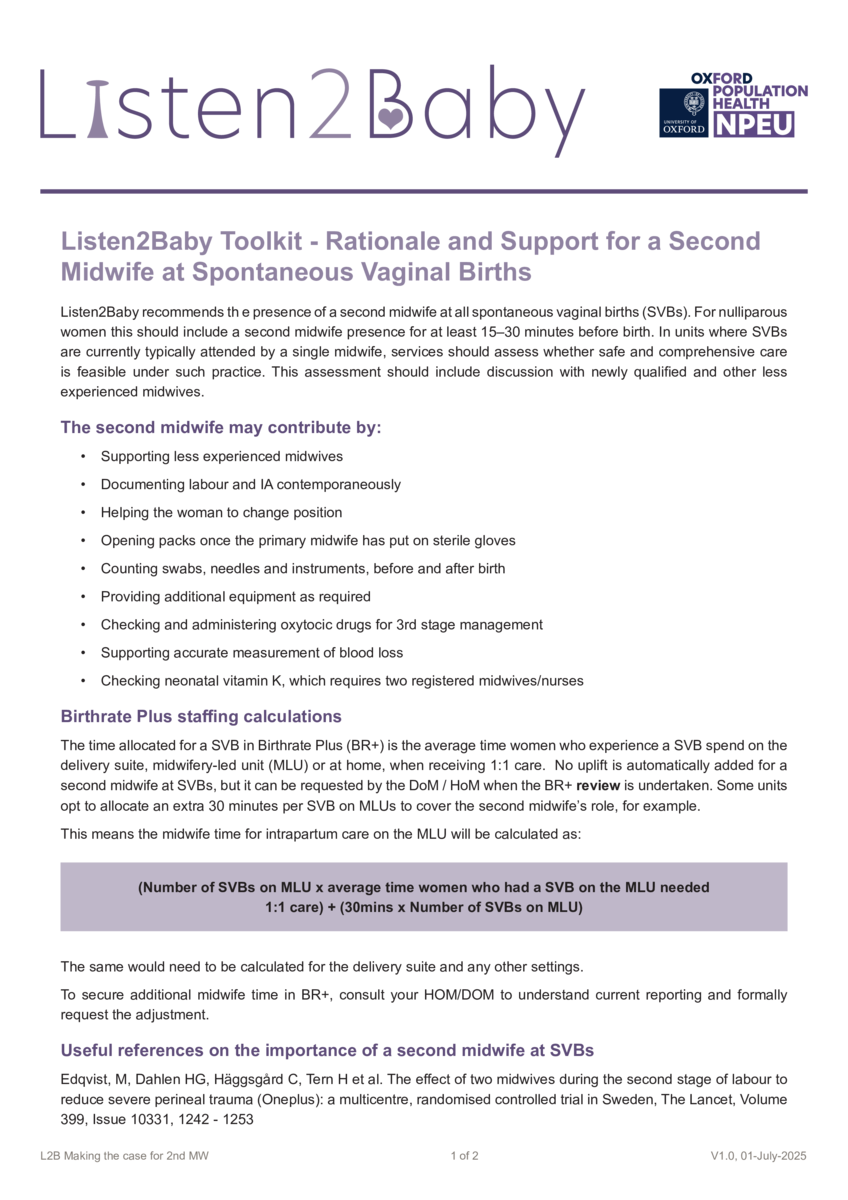
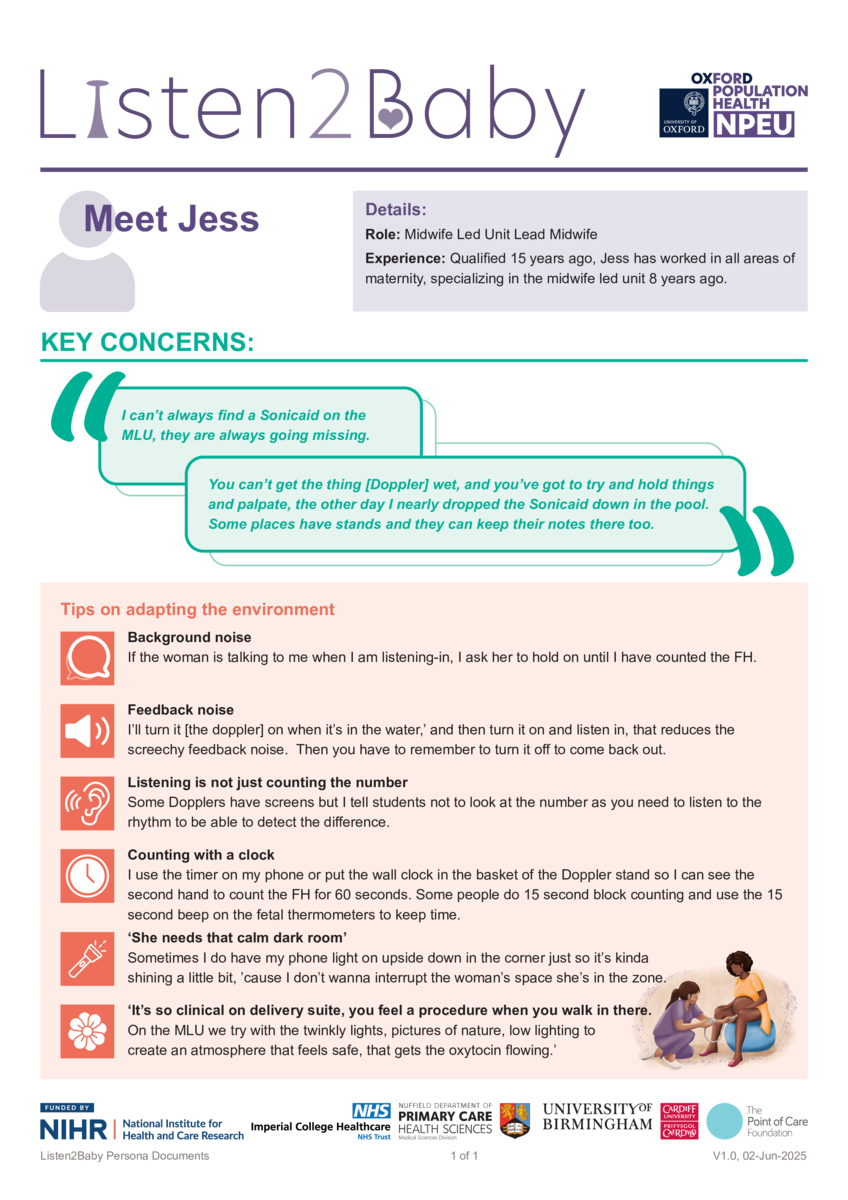
- Sub-optimal layout of birthing room
Documenting IA according to NICE guidance
Antenatal
- Antenatal discussion of fetal monitoring options (NICE Guideline NG229, 2022; section 1.1.1)
- Decision about fetal monitoring resulting from antenatal discussion (NICE Guideline NG229, 2022; section 1.1.1)
- Detail of support given during discussion & decisions involving fetal monitoring options, including involvement of birth companion (NICE Guideline NG229, 2022; section 1.1.3)
Intrapartum - First stage
- Fetal heart rate as a single rate on the partogram and in woman’s notes every 15 minutes (NICE Guideline NG229, 2022; section 1.2.9)
- Any accelerations and/or decelerations of the fetal heart (NICE Guideline NG229, 2022; section 1.2.9)
- Maternal pulse on the partogram every hour, or more if concerned (NICE Guideline NG229, 2022; section 1.2.9)
Intrapartum - Second stage
Fetal heart rate as a single rate on the partogram and in woman’s notes every 5 minutes (NICE Guideline NG229, 2022; section 1.2.10)
Next Steps
Think about what is recorded and how.
Resources

Setting up the birth room to support documentation
Document to come here
Action
Download all documents (tbc)






 This study is funded by the National Institute for Health and Care Research (NIHR)